


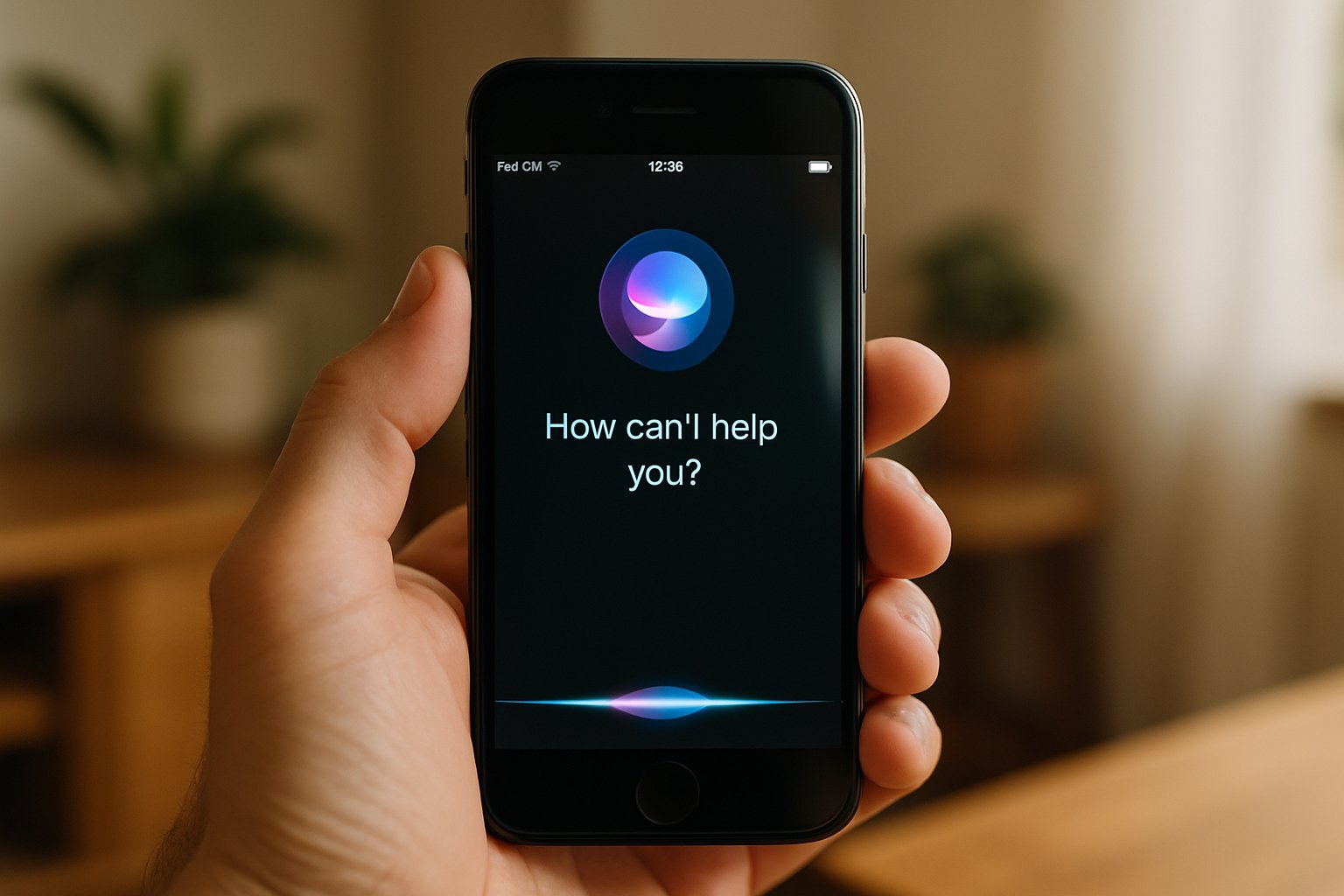

Apple is entering a phase in the artificial intelligence race, placing a renewed focus on transforming Siri into a next-generation AI assistant. After years of criticism that its voice assistant lagged behind competitors, the company is now preparing a comprehensive overhaul—one that could redefine how users interact with the entire Apple ecosystem.
- A Strategic Shift Toward AI-Centric Innovation
- Siri’s Biggest Upgrade Yet
- Opening Siri to Third-Party AI
- The Role of Apple Intelligence
- Partnership with Google and AI Infrastructure
- A New Interface and Experience
- Challenges and Delays
- What This Means for Users
- The Bigger Picture: Apple’s AI Future
- Conclusion
A Strategic Shift Toward AI-Centric Innovation
As Apple marks over five decades in the tech industry, artificial intelligence has become central to its future growth strategy. The company is expected to showcase major AI advancements at its upcoming Worldwide Developers Conference (WWDC), with Siri positioned as the centerpiece of this transformation.
This shift reflects broader industry pressure. Competitors like Google, OpenAI, and Anthropic have rapidly advanced conversational AI systems, pushing Apple to accelerate its own efforts and rethink how Siri operates.
Siri’s Biggest Upgrade Yet
The upcoming version of Siri—expected to roll out with iOS 27, iPadOS 27, and macOS 27—will represent the assistant’s most significant evolution since its launch.
Key expected improvements include:
- Multi-step command processing
Siri is being redesigned to handle multiple requests in a single query, allowing users to perform complex tasks more naturally. - Chatbot-like conversations
Instead of simple voice commands, Siri will support back-and-forth dialogue similar to modern AI chatbots, enabling deeper interaction and contextual understanding. - Cross-app functionality
The assistant will be able to execute tasks across apps—such as editing content, sending messages, or retrieving information—without requiring manual navigation. - Context awareness
Siri is expected to use personal data (securely) to deliver more relevant and personalized responses.
These upgrades aim to transform Siri from a reactive tool into a proactive digital assistant.
Opening Siri to Third-Party AI
One of the most significant changes in Apple’s strategy is its willingness to integrate third-party AI models directly into Siri.
Reports indicate that Apple plans to introduce an “Extensions” system, allowing external AI services—such as Google’s Gemini or Anthropic’s Claude—to operate within the Siri interface.
This approach marks a major philosophical shift. Rather than relying solely on its own AI models, Apple is building a platform-based AI ecosystem, where users can choose which AI handles specific tasks.


Why this matters:
- Users gain flexibility and better results depending on the task
- Developers can extend Siri’s capabilities
- Apple can monetize AI integrations through subscriptions
The Role of Apple Intelligence
At the core of this transformation is Apple Intelligence—the company’s unified AI framework designed to work across iPhone, iPad, Mac, and other devices.
Unlike many competitors, Apple emphasizes privacy-first AI:
- On-device processing for sensitive data
- Secure cloud computation via Private Cloud Compute
- Minimal data collection by design
This hybrid approach allows Apple to deliver powerful AI features while maintaining its long-standing privacy positioning.
Partnership with Google and AI Infrastructure
In a notable move, Apple has partnered with Google to leverage its Gemini AI models as part of the Siri overhaul.
This collaboration enables Apple to:
- Accelerate development of advanced AI features
- Compete with leading chatbot platforms
- Integrate large-scale models without fully building them from scratch
At the same time, Apple continues developing its own AI technologies, combining internal innovation with external partnerships.
A New Interface and Experience
Beyond functionality, Apple is also rethinking how users interact with Siri.
According to reports, the company is testing:
- A standalone Siri app with chat-style interaction
- Enhanced UI with richer responses (summaries, visuals, structured answers)
- Deeper system integration, potentially replacing traditional search interfaces
These changes suggest Siri could evolve into a central AI hub, rather than just a voice assistant.
Challenges and Delays
Despite its ambitious plans, Apple’s AI journey has not been without setbacks. The rollout of advanced Siri features has faced delays due to technical challenges and performance issues.
Historically, Siri has struggled with:
- Limited contextual understanding
- Inconsistent performance
- Reliance on external models like ChatGPT
The upcoming overhaul is Apple’s opportunity to address these weaknesses and regain competitiveness.
What This Means for Users
If Apple successfully delivers on its vision, users can expect:
- More natural conversations with Siri
- Faster and smarter task execution
- Personalized assistance across devices
- Access to multiple AI systems through a single interface
In essence, Siri could become a true digital assistant, capable of understanding intent, context, and complex workflows.
The Bigger Picture: Apple’s AI Future
Apple’s renewed focus on Siri signals a broader transformation. Rather than competing directly on raw AI model power, the company is leveraging its strengths:
- A tightly integrated hardware-software ecosystem
- Strong privacy positioning
- A massive global user base
- A developer-friendly platform approach
This strategy could allow Apple to redefine the AI experience—not by building the smartest model, but by delivering the most seamless and user-centric one.
Conclusion
Apple’s plans to upgrade Siri represent more than just a feature update—they mark a fundamental shift in the company’s approach to artificial intelligence. By combining advanced AI capabilities, third-party integrations, and privacy-focused design, Apple is positioning Siri to become a central pillar of its ecosystem.
The success of this strategy will likely determine Apple’s standing in the next era of computing—where AI is not just a feature, but the foundation of the user experience.